Good fit
Repeated trigger formats where automatic orientation and tube-controlled placement are needed to support an inline capping process.
Trigger closure feeding
A closure-specific vibratory-bowl and pick-and-place system for orienting trigger heads, controlling dip tubes and presenting the closure to a bottle.
Direct model answer
The LU-XG446S is a trigger-closure feeding and placement route rather than a general-purpose cap bowl. It uses a vibratory bowl, controlled transfer and pneumatic placement so the trigger head and dip tube can be presented to the bottle before final tightening or the next machine operation.
The values below are current Lancing reference data for initial project screening. They do not prove that every bottle and closure inside a dimensional range will run, or that the published rate will be sustained on a different line. Lancing confirms the final configuration, tooling, utilities, output and acceptance method against representative production samples and the complete application brief.
Published reference envelope
Use these values to decide whether the platform merits a sample review. Unknown or project-specific items remain part of the quotation and trial process.
| Published item | Reference value |
|---|---|
| Model reference | LU-XG446S |
| Machine route | Automatic trigger cap feeding and placement |
| Published suitable cap size | Approx. Ø15–35 mm |
| Published bottle height | Approx. 10–280 mm |
| Published working speed | 20–25 bottles/min |
| Electrical supply | 110/220 V, 50–60 Hz |
| Power | 250 W |
| Main package size | Approx. 1420 × 680 × 1740 mm |
| Bowl package size | Approx. 940 × 930 × 820 mm |
| Approximate package weights | 210 kg main unit plus 153 kg bowl package |
Machine route
The image supports identification of the machine route. It does not establish suitability for a different bottle, cap, speed or line arrangement.
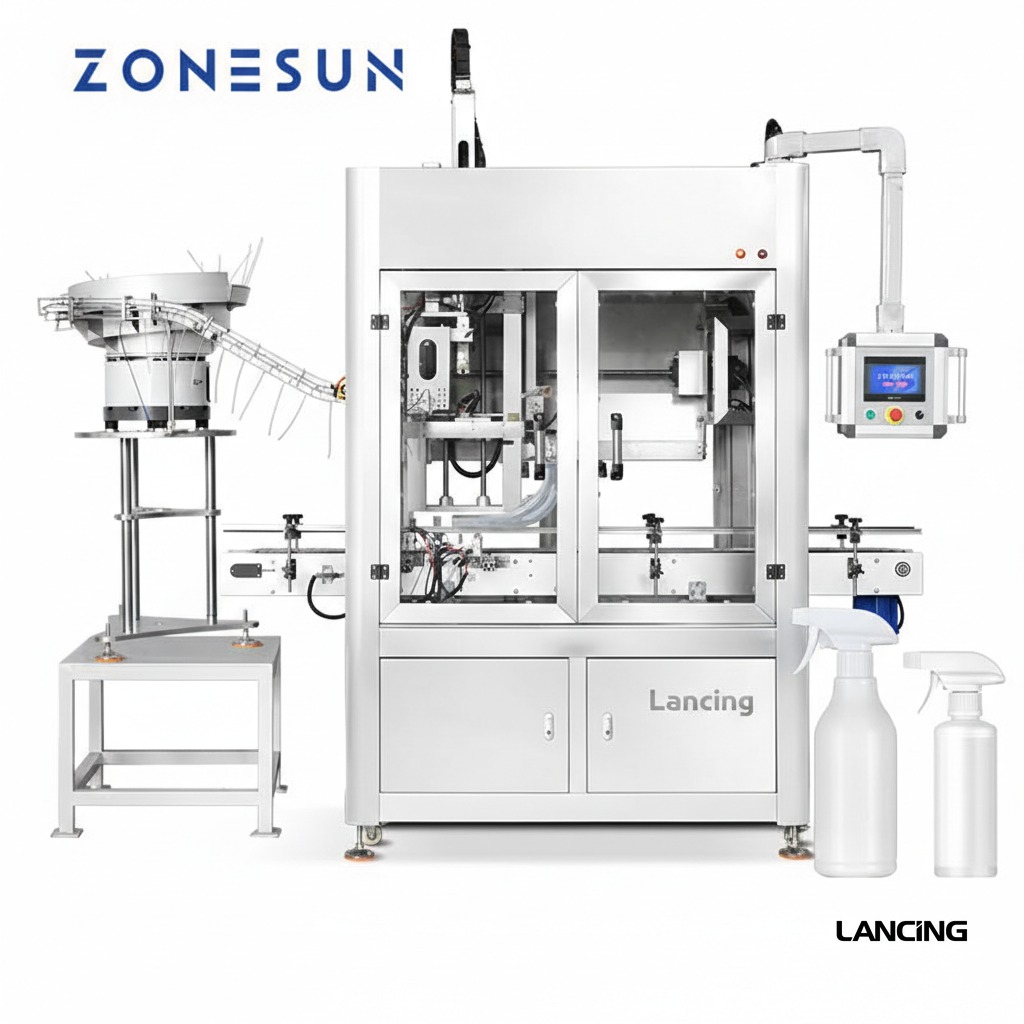
LU-XG446S
Published first-party model image used as a visual reference. Final guarding, tooling and line arrangement are confirmed for the quoted machine.
Selection boundary
A trigger head is not defined by cap diameter alone. The body shape, actuator orientation, shroud, thread, dip-tube length, tube curvature and bottle neck position all affect whether it can be separated, oriented and placed reliably.
Repeated trigger formats where automatic orientation and tube-controlled placement are needed to support an inline capping process.
Closures with long or curved tubes, multiple trigger-head orientations, flexible shrouds, mixed component lots or bottles with restricted neck access.
Manual placement may remain more practical for very short batches, frequent unrelated closure changes or triggers that cannot be separated reliably without dedicated tooling.
Production evidence
A feeder should not be accepted on a short steady-state demonstration alone. The test should include a normal refill, low-cap condition, recirculated closures, a planned stop, restart and the recovery of a trigger or tube that does not present correctly. Count orientation and placement losses separately from final tightening defects.
Confirm the agreed quantity and method do not tangle dip tubes or damage trigger heads.
Observe rejected and recirculated closures as well as accepted parts at the transfer point.
Prove that the dip tube enters the bottle without folding, snagging, missing the neck or disturbing the bottle.
Define how the placed trigger is held, tightened and inspected by the next station or integrated capper.
Quotation and trial brief
A useful quotation should describe the operating duty and acceptance evidence, not only the nominal bottle and cap diameter.
Provide filled production bottles, every closure variant, component drawings where available, product condition and the least stable or most difficult format.
State required accepted output, batch size, shift pattern, changeover frequency, operator tasks and whether cap placement is manual or automatic.
Provide the layout, conveyor direction and height, available space, utilities, connected machinery, control requirements and the quality checks used to release the finished pack.
Buyer questions
These answers clarify the model boundary before a formal sample and project review.
No. The published diameter is a screening value only. Trigger geometry, tube length, head orientation, flexibility and bottle-neck access must all be assessed with production components.
The model is presented as a trigger feeding and placement route. Final tightening and the exact machine sequence depend on the quoted configuration and connected capping equipment.
Trigger closures can behave differently as the bowl load changes. A refill may temporarily increase tangling or recirculation, so sustained output should include normal replenishment rather than a carefully prepared short run.
Provide normal production triggers and dip tubes from representative component lots, filled bottles, dimensional drawings where available, the required head orientation, output target and finished-pack acceptance checks.