Good fit
Higher-output ROPP lines using approved aluminium closures, stable bottles and a defined cap-feeding and transfer arrangement.
Automatic multi-head ROPP
A rotary eight-head ROPP capping route for higher-output aluminium closure lines with automatic bottle transfer and coordinated cap presentation.
Direct model answer
The LU-XG440C8 is an eight-head automatic ROPP capping platform for production lines that need coordinated bottle transfer, cap supply and closure forming at a higher reference capacity than an operator-loaded machine. The quoted system must be based on the actual aluminium closure, neck finish, bottle and connected-line duty.
The values below are current Lancing reference data for initial project screening. They do not prove that every bottle and closure inside a dimensional range will run, or that the published rate will be sustained on a different line. Lancing confirms the final configuration, tooling, utilities, output and acceptance method against representative production samples and the complete application brief.
Published reference envelope
Use these values to decide whether the platform merits a sample review. Unknown or project-specific items remain part of the quotation and trial process.
| Published item | Reference value |
|---|---|
| Model reference | LU-XG440C8 |
| Machine route | Automatic rotary eight-head ROPP capper |
| Published reference capacity | 7,500 pieces/hour |
| Bottle diameter | 30–90 mm |
| Bottle mouth range | 22–38 mm |
| Bottle height | 100–330 mm |
| Published power | 2.2 kW |
| Approximate machine size | 1700 × 1100 × 2000 mm |
| Cap feeding and line interfaces | Confirmed for the selected closure and complete project scope |
Machine route
The image supports identification of the machine route. It does not establish suitability for a different bottle, cap, speed or line arrangement.
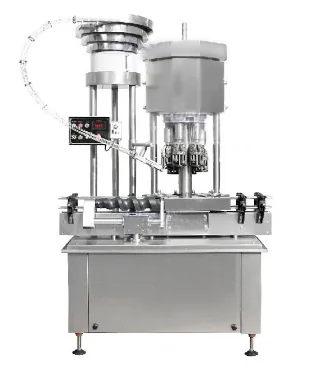
LU-XG440C8
Representative multi-head ROPP image. The final LU-XG440C8 head count, guarding, cap feed and line arrangement are confirmed in the quotation.
Selection boundary
A multi-head ROPP system is justified when accepted-output demand, closure supply and bottle transfer require automatic continuous production. More heads increase capacity only when every station, component and line interface performs consistently.
Higher-output ROPP lines using approved aluminium closures, stable bottles and a defined cap-feeding and transfer arrangement.
Component tolerances, shell decoration, liner behaviour, bottle-neck variation, pressurised products and formats near the published dimensional limits.
A single-head semi-automatic ROPP machine may be more appropriate for low volumes, frequent format changes or projects that cannot yet justify automatic cap feeding and rotary transfer.
Production evidence
An eight-head capper needs station-by-station evidence. Samples should be identified by head position so quality teams can distinguish a component issue from one roller setup, transfer position or recurring timing condition. The timed run must also include cap replenishment, normal line stops and downstream accumulation.
Prove orientation, chute or starwheel handover, low-level response and normal replenishment.
Confirm infeed spacing, rotary handling, support and outfeed across the full approved format set.
Sample every capping head and compare formed threads, skirt, tamper band, cap height, opening and sealing checks.
Record accepted output, rejects, stops, restart behaviour and the actual constraint over an agreed production-representative run.
Quotation and trial brief
A useful quotation should describe the operating duty and acceptance evidence, not only the nominal bottle and cap diameter.
Provide filled production bottles, every closure variant, component drawings where available, product condition and the least stable or most difficult format.
State required accepted output, batch size, shift pattern, changeover frequency, operator tasks and whether cap placement is manual or automatic.
Provide the layout, conveyor direction and height, available space, utilities, connected machinery, control requirements and the quality checks used to release the finished pack.
Buyer questions
These answers clarify the model boundary before a formal sample and project review.
No. It is a published reference capacity. Sustainable accepted output depends on cap supply, bottle transfer, component quality, head setup, inspection, changeovers and upstream/downstream conditions.
Head-labelled samples reveal whether variation follows a particular roller station or is distributed across components and line conditions. This makes fault investigation and preventive maintenance more precise.
The complete cap-feeding and transfer scope must be confirmed for the selected closure. Bowl, elevator, chute, hopper and buffer arrangements depend on cap geometry and required autonomy.
FAT should use agreed production samples and cover all heads, normal replenishment, stop/restart conditions, finished-pack checks, changeover evidence, controls and a timed accepted-output run.