Good fit
Inline bottle lines using screw caps, spray caps or pump closures where bottle detection and an indexed capping action suit the required process.
Automatic single-head capper
An inline pneumatic capping route combining bottle detection, controlled positioning and automatic tightening for screw caps, spray closures and pump formats.
Direct model answer
The LU-XG16-class machine is an automatic inline capper that detects and controls each bottle at a capping station. It can be considered when the line needs automatic bottle transport and tightening but does not require a continuous multi-spindle system. Cap presentation may remain manual or be integrated with a suitable feeder.
The values below are current Lancing reference data for initial project screening. They do not prove that every bottle and closure inside a dimensional range will run, or that the published rate will be sustained on a different line. Lancing confirms the final configuration, tooling, utilities, output and acceptance method against representative production samples and the complete application brief.
Published reference envelope
Use these values to decide whether the platform merits a sample review. Unknown or project-specific items remain part of the quotation and trial process.
| Published item | Reference value |
|---|---|
| Model reference | LU-XG16 class |
| Machine route | Automatic inline single-head / pneumatic capper |
| Bottle height | 30–300 mm |
| Bottle diameter | 20–160 mm |
| Cap diameter | 18–70 mm |
| Published working speed | 20–60 bottles/min |
| Working pressure | 0.4–0.6 MPa |
| Electrical supply | AC 220/110 V, 50–60 Hz |
| Cap feeding | Bowl or elevator optional |
| Approximate machine size | 1930 × 740 × 1600 mm |
| Approximate machine weight | 150 kg |
Machine route
The image supports identification of the machine route. It does not establish suitability for a different bottle, cap, speed or line arrangement.
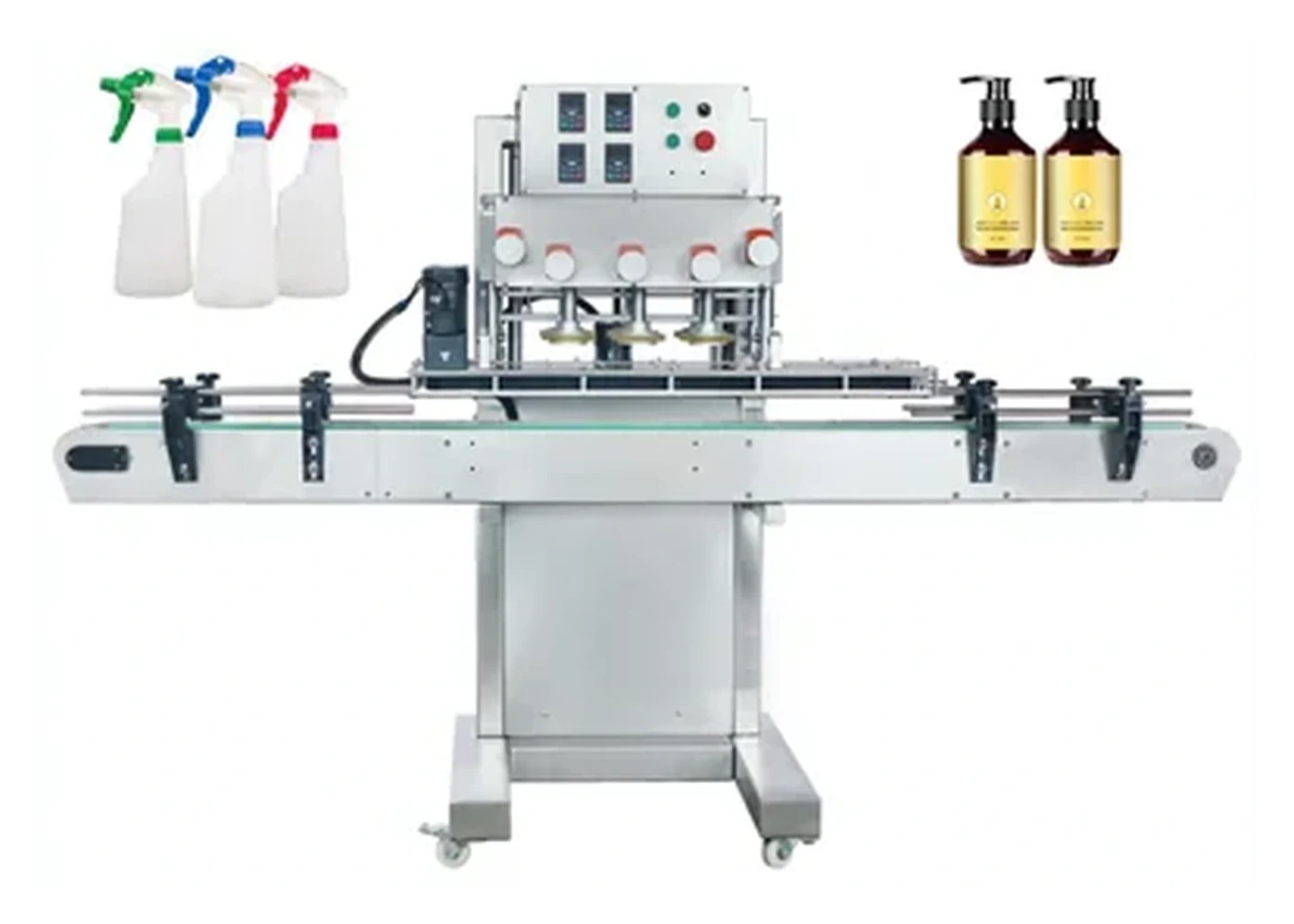
LU-XG16 class
Published first-party model image used as a visual reference. Final guarding, tooling and line arrangement are confirmed for the quoted machine.
Selection boundary
This platform suits projects that need automatic conveyor handling and a controlled capping action across a relatively broad bottle and cap envelope. The published dimensions are a screening range, not proof that every combination inside the range will run without format tooling.
Inline bottle lines using screw caps, spray caps or pump closures where bottle detection and an indexed capping action suit the required process.
Pumps and triggers with long dip tubes, unstable bottles, closures that arrive without a reliable thread start, and packs that need specific orientation.
Use a spindle system for continuous higher-output screw-cap duties or a specialist trigger/pump placement system when tube and head orientation dominate the task.
Production evidence
Automatic operation needs a known state at every step: bottle detected, bottle positioned, cap available, closure located, head cycle completed, bottle released and outfeed clear. The fault and restart sequence should identify uncertain bottles so they are inspected rather than silently returned to production.
Verify sensor detection, spacing and repeatable stopping across the intended format range.
Confirm whether an operator or feeder presents the closure and what happens when a cap is absent or inverted.
Use the correct head or chuck and prove the finished cap height, thread engagement, appearance and torque check.
Prove outfeed transfer, blocked-line response and recovery after a stop without losing bottle identity or spacing.
Quotation and trial brief
A useful quotation should describe the operating duty and acceptance evidence, not only the nominal bottle and cap diameter.
Provide filled production bottles, every closure variant, component drawings where available, product condition and the least stable or most difficult format.
State required accepted output, batch size, shift pattern, changeover frequency, operator tasks and whether cap placement is manual or automatic.
Provide the layout, conveyor direction and height, available space, utilities, connected machinery, control requirements and the quality checks used to release the finished pack.
Buyer questions
These answers clarify the model boundary before a formal sample and project review.
No. It is an automatic inline single-head/pneumatic route. A spindle capper uses several rotating contacts and normally tightens pre-placed caps continuously while bottles travel through side belts.
The published specification lists a cap bowl or elevator as optional. The correct bowl, track, chute and placement method depend on the actual closure and should be confirmed by sample testing.
The platform may be configured for several closure families, but head tooling, guides, bottle control and cap presentation can change. Each format must be listed, sampled and included in the approved quotation scope.
Define ready, running, starved, blocked and fault states, cap-low behaviour where a feeder is fitted, emergency-stop interfaces, queue control and the restart sequence after an interruption.